
We Were Never the Problem
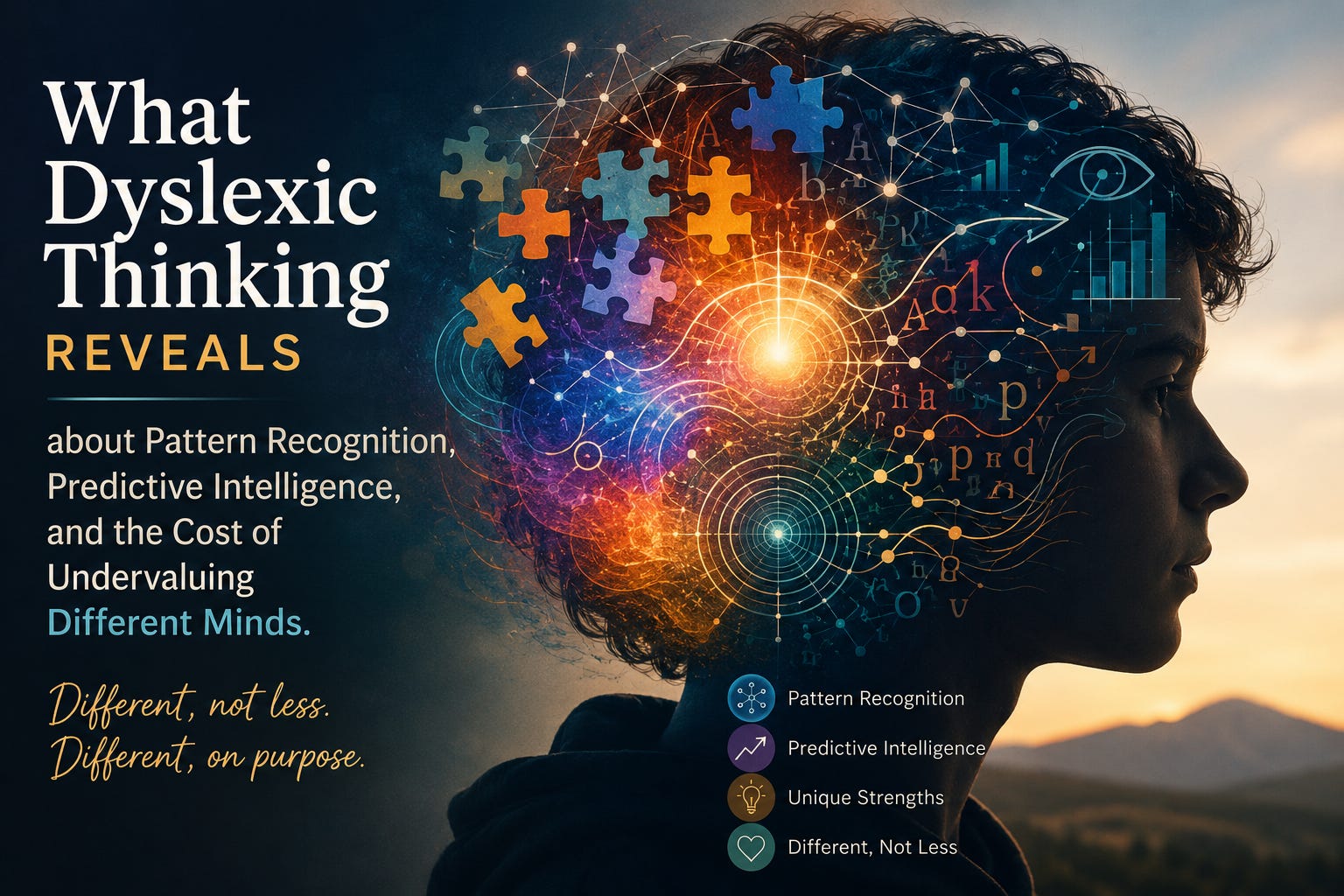
What dyslexic thinking reveals about pattern recognition, predictive intelligence, and the cost of undervaluing different minds.

What dyslexic thinking reveals about pattern recognition, predictive intelligence, and the cost of undervaluing different minds.
There’s a narrative I’ve lived with my entire life.
That something about the way I think is wrong.
That I process information differently because I’m dyslexic—and that difference is a deficit. Something to work around. Something to overcome.
But what if that narrative is wrong?
What if the very thing I was told was a limitation… is actually the reason I can see what others miss?
For years, dyslexic thinkers have been measured against a system that was never designed for them—a system that rewards speed, memorization, and linear processing. And when we don’t fit that mold, the conclusion has been simple: something is wrong. But that conclusion is starting to crack.
A recent Forbes article, “Dyslexic Thinking: The Untapped Superpower That Could Fuel U.S. Economic Growth,” (LINK TO THE FULL ARTICLE)highlights something many of us have known intuitively for a long time—that dyslexic thinking is not a weakness, but an untapped advantage. A way of processing information that supports innovation, pattern recognition, and complex problem solving at scale. In other words, the very minds that have been underestimated are now being recognized as economically valuable.
This isn’t new—it’s just newly acknowledged. Organizations like NASA and British intelligence have long recognized the value of dyslexic thinking in high-stakes, complex environments.
And that matters.
Because this isn’t just about learning differences. It’s about what kinds of thinking we value—and for decades, the system has been getting that wrong.
Dyslexia is not something I have. It’s something I am. And it fundamentally shapes how I see the world.
While others focus on individual data points, dyslexic thinkers often operate differently. We absorb information over time. We build internal maps. We track patterns—subtly, continuously—until something begins to take shape. And when it does, something else emerges that isn’t talked about nearly enough: predictive thinking.
Not prediction in the sense of guessing.
But the ability to sense where things are heading based on accumulated patterns, lived experience, and stored information over time. It’s the capacity to step back, see the system as a whole, and recognize shifts before they become obvious.
Which brings me to something that’s been bothering me.
We didn’t miss the information.
We missed the pattern.
And maybe that’s the deeper issue. Not a lack of intelligence. Not a lack of data. But a lack of diversity in thinking at the decision-making level.
For too long, dyslexic thinkers have been asked to adapt to systems that diminish their strengths—systems that chip away at confidence, that mistake difference for deficiency, that leave people questioning their intelligence instead of recognizing their capability. There is a real cost to that. Not just personally, but collectively. Lost confidence. Lost contribution. Lost opportunity.
But something is shifting.
And it feels, honestly, like a kind of vindication.
A quiet but powerful acknowledgment that there was never anything wrong with the way we think—we were simply being measured by the wrong standard.
And now, those same thinking patterns are being recognized as necessary. Valuable. Even economically significant.
So the question becomes: what happens if we stop trying to fix dyslexic thinkers—and start building systems that actually leverage them?
What happens when we bring pattern recognition, systems thinking, and predictive awareness into leadership, into decision-making, into environments that shape outcomes at scale?
If you’re someone who has been told you think differently—who sees patterns, feels shifts, or struggles to explain what you know but can’t always articulate in the moment—you’re not alone. That way of thinking has value. Real value.
It’s also something that can be understood, developed, and trusted.
This is the work I do now—helping individuals recognize how they think, rebuild confidence in it, and learn how to apply it in a way that is grounded, effective, and aligned with who they are.
If that resonates with you, I’d love to connect.