
The Current Doesn’t Negotiate
Training, awareness, and the power of surrender

The Current Doesn’t Negotiate
Training, Awareness, and the Power of Surrender
What diving for scallops actually looks like is very different from what most people imagine.
This isn’t a guided, buddy-based dive where you stay close, check in constantly, and move as a pair. In fact, it’s almost the opposite. We go out on a charter boat—usually with the same captain, someone we trust, someone who knows these waters as well as anyone can. There’s a familiarity to it, a quiet understanding among the group. Everyone knows what they’re doing. Everyone respects the conditions.
And then, one by one, we enter the water.
Independently.
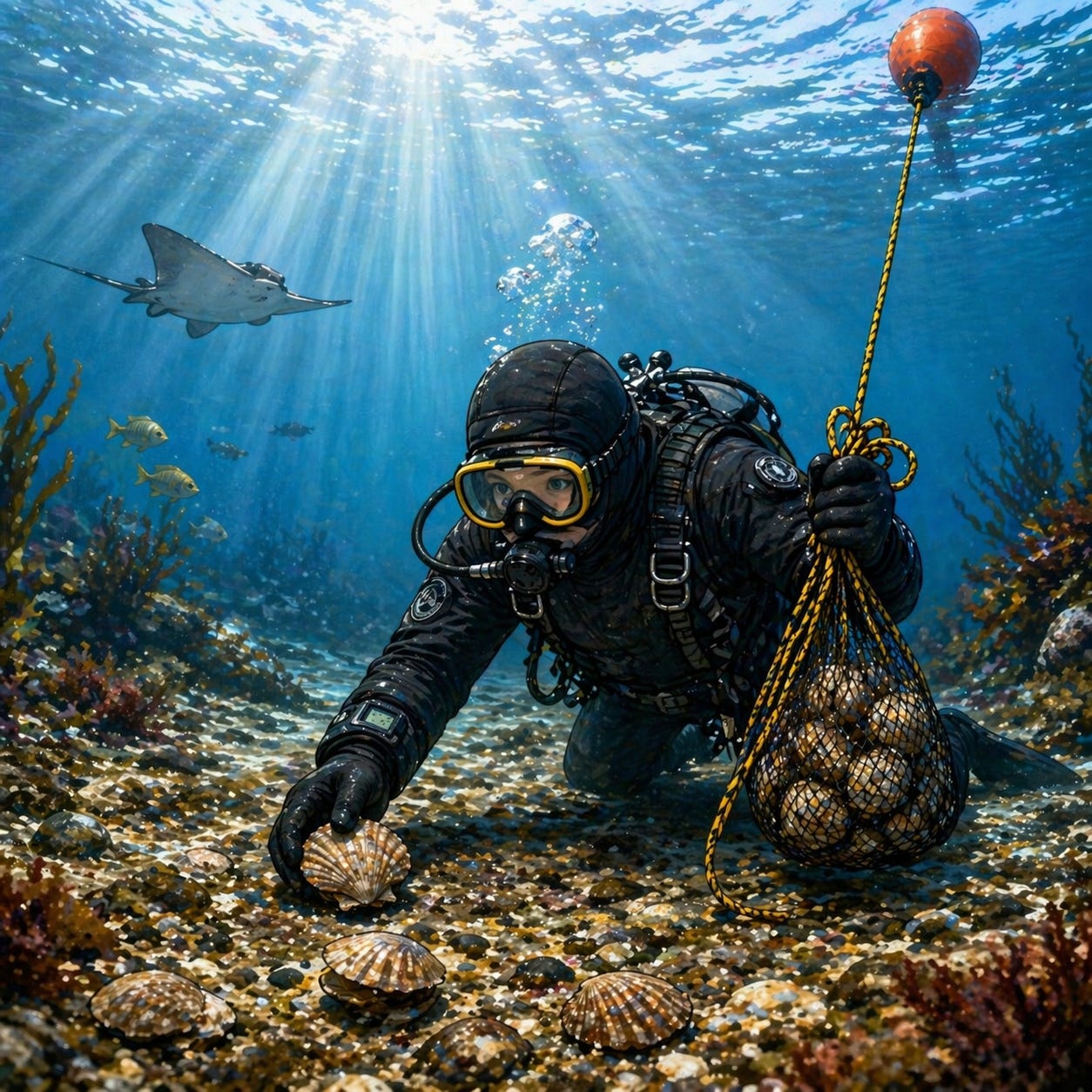
Each diver has a large poly ball, sometimes called a Gloster ball, a bright float on the surface—attached to a long line carefully wrapped into a bracket. That line is everything. It’s your reference point, your connection to the surface, and the way the captain tracks you as you move with the current.
We space ourselves out deliberately before entering. The last thing you want in water like this is tangled lines. There’s no room for carelessness here.
When it’s your turn, you step in, feel that immediate cold and understand why it is so important to be in a drysuit, and begin your descent. As you go down, you release the line, letting it play out smoothly above you as the poly ball rises and marks your position on the surface.
And then you reach the bottom.
That’s where it begins.
You’re Not Swimming—You’re Flying
With one hand, you hold onto your bracket—your anchor in a moving world. Clipped to it is your catch bag, secured with a carabiner, ready to fill.
And then… you let go of the idea of control.
Because you’re not swimming.
You’re flying.
The current takes you immediately—strong, insistent, undeniable. You don’t fight it. You can’t. Instead, you align with it, body angled just enough, awareness sharpened, eyes scanning the bottom ahead of you.
You learn quickly what to look for. Scallops don’t sit on smooth sand. They like gravel—textured, uneven patches where they blend in just enough to make you work for them.
And they move.
That was something I didn’t know the first time I dove for them.
I remember reaching down, confident—only to have the scallop shift away from my hand. It startled me. I laughed, bubbles escaping as the realization hit.
Of course.
They open and close their shells, hydropropelling themselves forward in short bursts. They aren’t waiting to be found. They’re alive. Responsive. Part of the same moving system you are.
From that moment on, everything changes.
It’s no longer collecting.
It becomes a rhythm—a timing between movement and response.
The Current Doesn’t Negotiate
As the current carries you forward—faster than you expect, faster than you can control—you reach down again and again, grabbing what you can, dropping each scallop into your bag in one fluid motion.
There’s no going back.
If you miss one, it’s gone.
The current doesn’t negotiate. It doesn’t allow for second chances.
You move forward. Always forward.
Your bag fills quickly. Heavier with each addition. You feel it in your arm, in your balance, in the way your body adjusts to the drag.
And when it’s full, you don’t fight that either.
You close it. Secure the carabiner. Let it hang.
Then slowly, deliberately, you make your way back up your line.
Surface and Return
Above you, your poly ball marks your place in a vast, moving system. On the surface, the captain is drifting with the same current, tracking each of us, watching, waiting.
We always dive on an outgoing tide—everything moving toward the ocean. That’s part of the safety. Part of the plan.
But even with preparation, there’s risk.
You stay aware. Always scanning ahead. The bottom isn’t clean—there are obstructions, debris, places where a line could catch. A moment of inattention can become something more serious.
So you stay present.
Completely.
Because in water like this, presence isn’t optional.
It’s everything.
When you break the surface, there’s a moment of stillness again—a reset. You give the okay signal by placing your hand on top of your head. The captain moves toward you, steady and practiced, and you climb back onto the boat. Only then do you pull your catch bag up and bring your scallops aboard.
One by one, the others surface.
One by one, we’re gathered back in.
And just like that, it’s over.
Except for the next part…
Which is a story all on its own.
It comes from training. From preparation. From understanding exactly what you’re stepping into before you ever enter the water.
Because once you’re in it, there is no forcing your way through.
There’s only awareness.
And choice.
That’s what struck me most—the paradox:
You are completely out of control…
and yet entirely responsible.
Responsible for your awareness.
For your positioning.
For how you respond to what’s coming next.
Because the current will take you.
That part is not negotiable.
But how you move within it?
That’s where everything happens.
Over time, you feel the difference between resisting and aligning. One exhausts you. The other carries you.
That lesson didn’t stay in the water.
Because there are moments in life—just like in that current—where force doesn’t work. Where pushing harder only creates more friction.
And the only real option is to pause… assess… and move with what’s already in motion.
Not blindly.
Not recklessly.
But with awareness.
With preparation.
With trust.
That’s what this kind of diving teaches you.
Not just how to move through water.
But how to move through uncertainty.